What Employees Are Actually Owed Over the Holidays
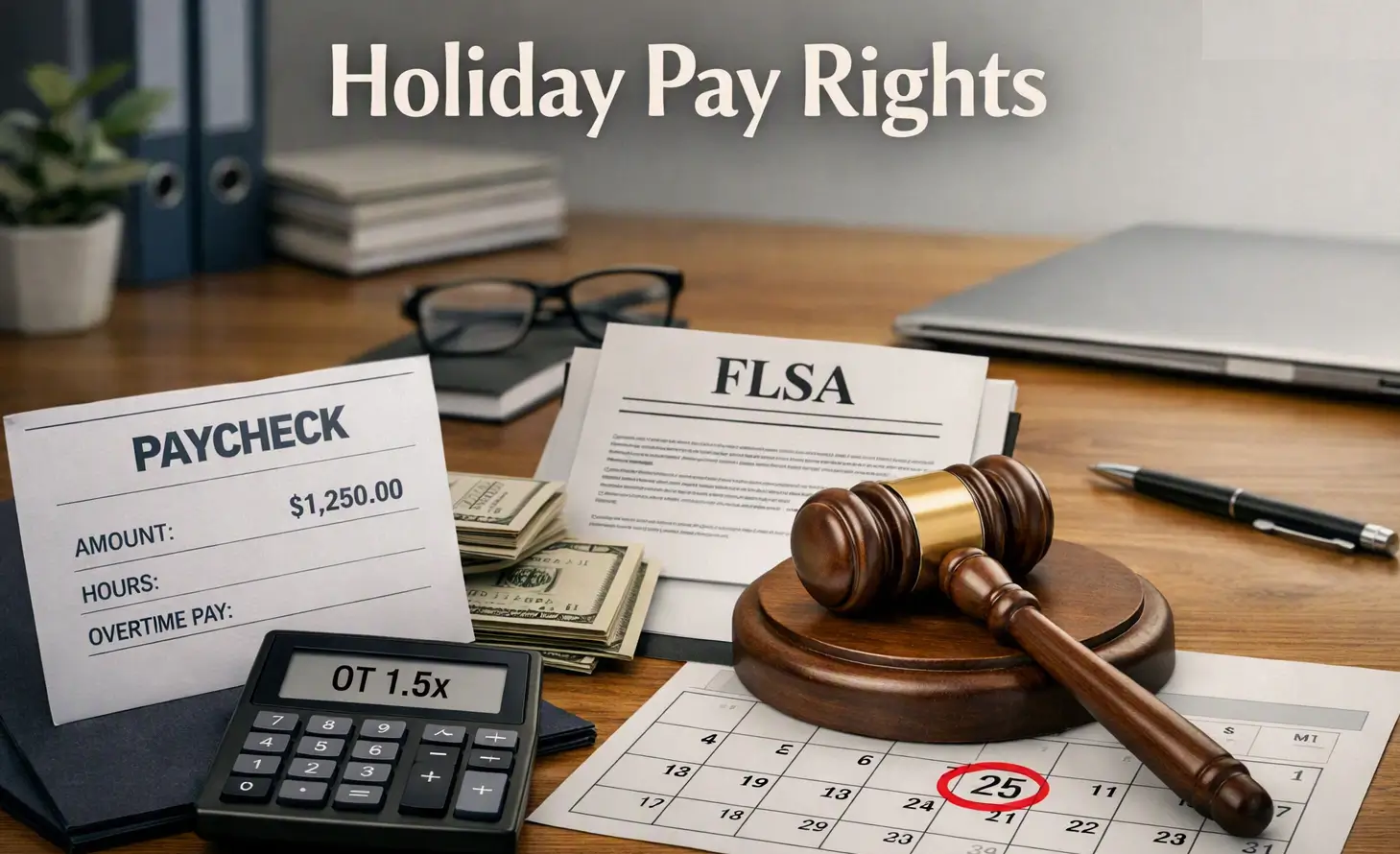
Holiday pay can be confusing. You may have scheduled work on a holiday, but that doesn’t automatically mean you are entitled to extra pay under federal law.
In 2025, 81% of private-industry workers had access to paid holidays, compared with 68% of state and local government workers. Thanksgiving Day itself was provided as a paid holiday to 97% of private-industry workers. However, the day after Thanksgiving was provided to only 39% of private-industry workers, according to BLS holiday-profile data. This was offered by many employers but was not considered a federal holiday.
There are several factors to consider whether you receive your holiday pay, overtime, paid time off, or holiday bonuses. They mostly depend on your employer’s policies, your employment agreement, applicable state law, and whether you are covered by federal wage protections.
Under the Fair Labor Standards Act (FLSA), there is no requirement for employers to pay employees for holidays they don’t work for. There is also no extra pay for them simply because it’s a holiday.
Let’s take a look at employee rights during the holiday season, when overtime rules apply and what to check if your holiday paycheck doesn’t look right.
In Some States the Federal Floor Is the Entire Story
In the state of Mississippi, there is no state minimum wage. This means that most workers in such places receive the minimum federal wage of $7.25 per hour. Alabama, Louisiana, South Carolina, and Tennessee are in similar situations.
Some other states have additional laws as well. For instance, Kentucky has an extra law that provides for overtime in particular cases where covered workers work for all seven days in a workweek. In states with their own overtime laws, employees covered by both state and federal requirements generally receive whichever standard provides the greater protection.
The holiday itself, however, does not automatically create a right to premium pay under federal law. The FLSA normally mandates time and a half for 40 hours or more per workweek, but there is no additional pay for working on a holiday such as Christmas or Thanksgiving.
In California It Is Barely a Starting Point
California runs daily overtime rather than only weekly. Time and a half past eight hours in a workday, double time past twelve, with separate rules again for a seventh consecutive day in the workweek. A single long holiday shift can generate overtime in California that produces nothing at all under the federal calculation.
Religious accommodation diverges further and in ways that decide cases. Title VII reaches private employers with fifteen or more employees. California’s Fair Employment and Housing Act reaches five. Its undue hardship standard is significant difficulty or expense, and Government Code section 12940 requires an employer to explore all reasonable alternative means of accommodating an observance before it can claim hardship at all.
The filing deadlines are not close. An EEOC charge runs 180 days from the discriminatory act, or 300 where a state or local agency also enforces anti-discrimination law. A complaint with California’s Civil Rights Department runs three years from the last date of harm.
According to Los Angeles employment lawyer Sang (James) Park, working with an experienced legal team is the best way to assess the available solutions to any employment-related issues or if you believe your employer has violated your rights.
What Groff Changed and What It Did Not
Federal accommodation law did move recently. In Groff v. DeJoy, the Supreme Court rejected reading its earlier case law as a de minimis cost test and held that an employer must show the burden of an accommodation would be substantial in the overall context of its particular business, weighing the nature, size, and operating cost of the employer.
That raised the federal bar for denying a religious accommodation. It did not raise it above what California already required.
Holiday Parties Are Still the Workplace
For employer-sponsored events, they have the same protections as a regular shift. Religious harassment violates Title VII where the conduct is severe or pervasive enough to create a hostile work environment. Other times, it even produces an adverse employment decision.
Repeated jokes about a coworker’s traditions and pressuring them to join religious activities are grounds to file a claim. Any derogatory comments about someone’s practice also create the same effect. The harasser may be a supervisor, a coworker, or a non-employee like a contractor or a client.
Documentation is what makes any of it actionable. It’s important to have the date, time and location of the incident. Include the specific conduct at issue and the names of anyone who witnessed it.
Scheduling emails, written denials of an accommodation request, and incident reports all belong in the same file. Once the issue is raised to your employer, they are given the chance to correct the problem.
The federal law sets a minimum standard for employment rights. Most of the real answer arrives from somewhere else. Which state, how many people the employer has, and whether a contract or a bargaining agreement promises more than the statute does.