Project Appraisal: Meaning, Process, Types & Methods
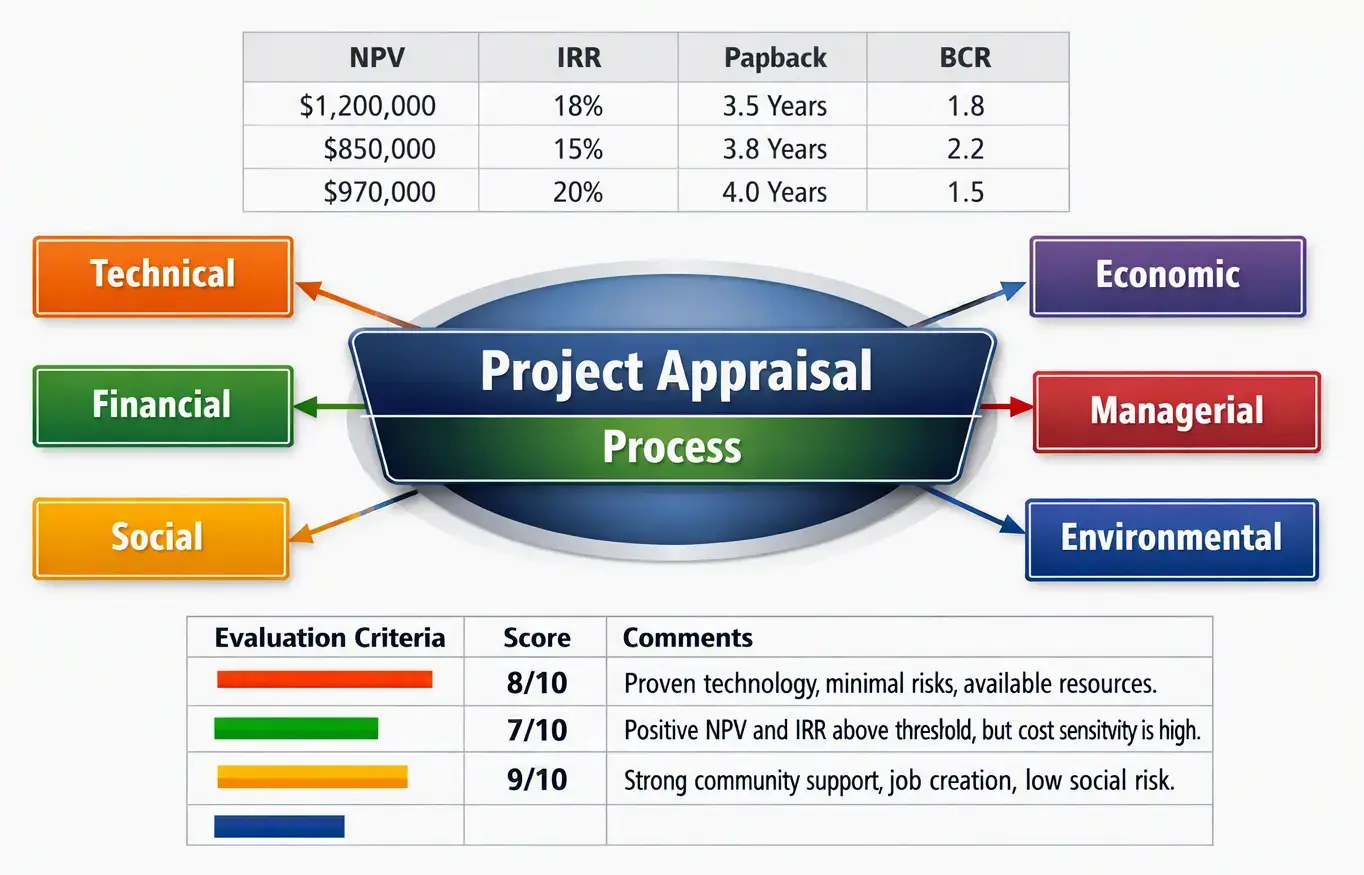
Table of Contents
Project appraisal is the structured review of a proposed project before any money is committed to it. The appraiser checks whether the project solves a real problem, whether it can be delivered with the available technology, people, and budget, and whether the expected benefits justify the cost. The output is a recommendation: approve the project, reject it, or send it back for changes.
Put simply, appraisal answers one question for whoever is paying: “Should we do this project, and is this the best way to do it?” It happens during initiation, after a project idea exists but before detailed planning starts. A bank reviewing a loan request, a PMO screening next year’s portfolio, and a ministry assessing a donor-funded road all run some version of the same process.
Key Takeaways
- Project appraisal is a go/no-go review of a proposed project, done before detailed planning and before funds are released.
- A full appraisal looks at the project from several angles: technical, commercial, financial, economic, managerial, social, and environmental.
- The financial part usually relies on four methods: net present value (NPV), internal rate of return (IRR), payback period, and benefit-cost ratio (BCR).
- Appraisal is not the same as evaluation. Appraisal happens before a project starts; evaluation looks back at a project that is running or finished.
- Need a starting point? Use the free project appraisal template below, or check what you remember with the 10-question quiz.
What Is Project Appraisal?
A working definition used in project management: project appraisal is the process of reviewing a proposed project to confirm that it addresses a real need, that the chosen solution is the best of the realistic alternatives, and that it is technically, financially, and organizationally feasible. Its purpose is to justify the project, or to stop it, before resources are spent.
The word “appraisal” means an expert assessment of value, which is why the same term shows up in real estate and HR (a property appraisal, an annual performance appraisal). In a project context it has a narrower meaning: judging the value and viability of a project that has not started yet.
Different standards place appraisal in slightly different spots. PRINCE2 builds it into the business case, which is written at the start and rechecked at every stage boundary. PMBOK-based practice treats it as part of project selection and initiation, before the charter is signed. Development banks and government agencies usually run it as a separate formal stage between identification and approval. The name and the paperwork change; the question stays the same.
Project Appraisal vs. Project Evaluation
The two terms get mixed up often, including in exam questions. Appraisal is ex ante: it happens before the project, uses estimates, and leads to a funding decision. Evaluation is ex post (or mid-term): it happens during or after the project, uses actual results, and leads to lessons learned or corrective action. If you are deciding whether to start, you are appraising. If you are checking whether it worked, you are evaluating.
Why Project Appraisal Matters
Most organizations have more project ideas than money and people to deliver them. Appraisal is the filter. It does four jobs:
- It stops weak projects early. Cancelling an idea on paper costs a few days of analysis. Cancelling it halfway through delivery costs the budget already spent.
- It lets you compare projects on the same scale. When two proposals compete for one budget, NPV and IRR give the sponsor numbers to compare instead of two enthusiastic pitches.
- It surfaces risks while they are still cheap to handle. A missing permit or an unrealistic sales forecast found during appraisal changes the plan. Found during execution, it changes the outcome.
- It creates a baseline. The assumptions written into the appraisal (costs, benefits, timeline) become the yardstick the project is measured against later.
From the field
The Truck Driver Next Door
For years I thought appraisal was something that happened in meeting rooms, with a PMP like me holding the pen. My neighbor, a truck driver, changed my mind. He had built a garage and redone his kitchen without ever calling either of them a project, and both turned out fine. One evening I went over to ask how he managed it. He was at the kitchen table with the Daily News spread out in front of him, the margins full of arrows, circles, and crossed-out lines. He was planning his next purchase: the big Mercedes truck he’d shown me in a trade magazine a month earlier.
Why not a proper plan or a spreadsheet, I asked. He shrugged. “Newspapers always lie. My notes are the only honest thing on the page.” Under the scribbles were the questions any appraisal asks: does he really need a new truck, what else could he do with the money, what will it cost, and how many loads before it pays for itself. He had never heard the word “appraisal.” He was doing it anyway, on newsprint, and that’s the process below.

Eric Morkovich, PMP
Project manager and long-time MyManagementGuide contributor
The Project Appraisal Process: 5 Steps
Textbooks list anywhere from four to seven stages. The version below covers what almost every organization does, whether the project is a new product line, an IT system, or a water supply scheme.
Step 1. Define the Problem and the Proposed Solution
Write down the problem or opportunity the project addresses, who is affected, and what happens if nothing is done. Then describe the proposed solution in one or two paragraphs. If you cannot state the problem clearly, the appraisal will not hold together, so this step deserves more time than it usually gets.
Step 2. Identify and Screen Alternatives
List the realistic ways to solve the same problem, including “do nothing” and “do the minimum.” A quick screen against cost, timing, and strategic fit removes the obvious non-starters. Two or three options should move on to detailed analysis. Skipping this step is the most common reason appraisals get sent back: the sponsor asks “did you consider X?” and the answer is no.
Step 3. Assess Feasibility From Every Angle
This is the core of the appraisal. Each shortlisted option is checked against the technical, commercial, managerial, social, and environmental aspects described in the next section. Much of this work overlaps with a feasibility study, and on larger projects the feasibility study report feeds straight into the appraisal. Stakeholder analysis belongs here too: who gains, who loses, and who can block the project.
Step 4. Run the Financial and Economic Analysis
Estimate the investment cost, operating costs, and expected cash inflows or savings year by year. Then apply the appraisal methods (NPV, IRR, payback, BCR) and test how sensitive the result is to your weakest assumptions. For public or donor-funded projects, an economic analysis adds costs and benefits to society that never show up as cash, such as travel time saved or pollution avoided.
Step 5. Write the Appraisal Report and Get a Decision
Pull the findings into one document: the problem, the options considered, the recommended option, the numbers, the main risks, and a clear recommendation. The sponsor or funding committee then approves, rejects, or asks for revisions. Once approved, the appraisal becomes the basis for the project charter and detailed planning. In our own practice, the approved package usually contains the problem statement, the options analysis, a broad scope statement, a preliminary schedule and cost projection, and a draft governance structure (who sponsors, who manages, who signs off).
Types (Aspects) of Project Appraisal
When people talk about “types” of project appraisal, they usually mean the different angles a project is examined from. A small internal project might only need the technical and financial checks. A factory, a hospital wing, or a donor-funded program will need all seven.
| Aspect | Key question | What gets checked |
|---|---|---|
| Technical | Can it be built and run? | Technology choice, location, capacity, equipment, suppliers, construction schedule, availability of skilled staff |
| Commercial (market) | Will anyone buy or use it? | Demand forecast, market size, competitors, pricing, distribution channels |
| Financial | Does it pay back for the investor? | Capital cost, operating cost, cash flows, sources of funding, NPV, IRR, payback, break-even |
| Economic | Is it worth it for society as a whole? | Economic costs and benefits, jobs created, effect on the region, shadow prices, economic rate of return |
| Managerial (organizational) | Can this organization deliver it? | Leadership, team capacity, governance structure, experience with similar projects |
| Social | Who is affected and how? | Impact on communities, employment, displacement, equity, stakeholder support |
| Environmental | What does it do to the environment? | Emissions, waste, land and water use, legal clearances, mitigation measures |
Financial and economic appraisal are the pair most often confused. Financial appraisal looks at the project from the owner’s point of view and uses market prices: will this investment earn its money back? Economic appraisal looks from the country’s or society’s point of view: taxes and subsidies are treated as transfers rather than costs, and benefits that nobody pays for directly are counted. A toll road can fail the financial test and still pass the economic one, which is exactly why governments sometimes fund it anyway.
Project Appraisal Methods and Techniques
The financial part of an appraisal relies on a small set of standard techniques. They split into two groups: methods that ignore the time value of money (simpler, rougher) and discounted cash flow methods (more work, more reliable).
Non-Discounted Methods
Payback period. How many years it takes for the project’s cash inflows to cover the initial investment. Shorter is better. It is easy to explain to a board and useful when cash is tight, but it ignores everything that happens after payback and treats a dollar in year four the same as a dollar today.
Accounting rate of return (ARR). Average annual accounting profit divided by the average investment. It uses figures managers already see in financial statements, which is its main appeal. Like payback, it ignores timing.
Discounted Cash Flow (DCF) Methods
Net present value (NPV). Every future cash flow is discounted back to today at the organization’s required rate of return (the discount rate), and the initial investment is subtracted. If NPV is above zero, the project earns more than that required rate and adds value. When options are mutually exclusive, the one with the highest NPV usually wins.
Internal rate of return (IRR). The discount rate at which NPV equals exactly zero. If IRR is higher than the required rate of return, the project is acceptable. IRR is popular because a percentage is easy to compare with a loan rate or a hurdle rate, but it can mislead when cash flows switch between positive and negative more than once.
Benefit-cost ratio (BCR). The present value of benefits divided by the present value of costs. A BCR above 1.0 means benefits outweigh costs; below 1.0 means they do not. Public agencies and development banks use BCR widely because it works for benefits that are not cash, such as time saved or health improved, once those benefits are given a money value.
Discounted payback period. The same idea as payback, but using discounted cash flows. It always comes out longer than simple payback and gives a more honest answer about when the money actually comes back.
Methods for Handling Uncertainty
Every number in an appraisal is a forecast, so a good appraisal shows what happens when the forecast is wrong. Sensitivity analysis changes one input at a time (sales volume down 20%, construction cost up 15%) and records the effect on NPV. Scenario analysis changes several inputs together to build a pessimistic, expected, and optimistic case. Break-even analysis finds the level of sales or usage at which the project stops losing money. Larger projects sometimes add Monte Carlo simulation, which runs thousands of random combinations of inputs to produce a probability range for NPV.
| Method | Accept the project if | Main strength | Main weakness |
|---|---|---|---|
| Payback period | Payback is shorter than the target (for example, 3 years) | Simple, shows liquidity risk | Ignores time value and later cash flows |
| ARR | ARR is above the target rate | Uses familiar accounting figures | Ignores timing of cash flows |
| NPV | NPV > 0 | Measures value added in money terms | Depends heavily on the chosen discount rate |
| IRR | IRR > required rate of return | Easy to compare with a hurdle rate | Can give odd results with irregular cash flows |
| BCR | BCR > 1.0 | Handles non-cash social benefits | Says nothing about the size of the project |
Worked Example: Appraising One Project
A distribution company is considering a warehouse automation system. It costs $100,000 upfront and is expected to save the company $30,000 in year 1, $35,000 in year 2, $40,000 in year 3, and $30,000 in year 4, after which the equipment is replaced. The company’s required rate of return is 10%.
| Year | Cash flow | Discount factor at 10% | Present value | Cumulative cash flow |
|---|---|---|---|---|
| 0 | -$100,000 | 1.000 | -$100,000 | -$100,000 |
| 1 | $30,000 | 0.909 | $27,273 | -$70,000 |
| 2 | $35,000 | 0.826 | $28,926 | -$35,000 |
| 3 | $40,000 | 0.751 | $30,053 | $5,000 |
| 4 | $30,000 | 0.683 | $20,490 | $35,000 |
- NPV: $27,273 + $28,926 + $30,053 + $20,490 – $100,000 = $6,741. Positive, so the system earns more than the 10% the company requires.
- IRR: about 13.0%, which is above the 10% hurdle.
- Payback period: after two years $35,000 is still outstanding, and year 3 brings $40,000, so payback is 2 + 35/40 = 2.9 years. On a discounted basis it is about 3.7 years.
- BCR: $106,741 / $100,000 = 1.07.
Every method says “accept,” but the margin is thin. A sensitivity check shows why that matters: if the savings come in about 6% lower than forecast in every year, NPV drops to roughly zero. Before approving, a careful sponsor would ask how solid the savings estimate is and whether the vendor will guarantee any of it. That conversation, prompted by the numbers, is the real value of the appraisal.
Project Appraisal in Entrepreneurship
For an entrepreneur, project appraisal usually happens twice. First, the founder appraises their own idea to decide whether it is worth leaving a job or investing savings. Second, a bank, investor, or government scheme appraises the same project before lending or investing. Lenders typically ask for a detailed project report that covers the market, technical setup, cost of the project, means of finance, projected profit and loss, and repayment capacity.
The aspects are the same as in the table above, but the weight shifts. Commercial appraisal (is there real demand?) and financial appraisal (can the business service its debt?) dominate, because most new ventures fail on one of those two. Lenders also look closely at the promoter: their experience, their own contribution to the capital, and whether the plan is realistic about the first two or three years of cash flow.
Project Appraisal Document (PAD)
If you searched for “project appraisal document,” you may be looking for the World Bank’s PAD. This is the formal document World Bank teams prepare for an investment project before it goes to the Board for approval. It sets out the project’s development objective, components, costs and financing, implementation arrangements, results framework, and the technical, economic, fiduciary, social, and environmental appraisal behind it. PADs for approved projects are usually published on the World Bank’s projects website, which makes them a useful reference if you need to see how a large, multi-aspect appraisal is written up in practice.
Other development lenders use similar documents under different names. Consultants who write terms of reference for donor-funded work will often find the appraisal requirements spelled out in the funder’s own guidelines.
Free Project Appraisal Template
The template follows the five steps above. It has sections for the problem statement, options analysis, a feasibility checklist for each of the seven aspects, a cash flow table with NPV, IRR, payback, and BCR, a risk and sensitivity summary, and a recommendation and sign-off page. Delete the sections your project does not need; a small internal project might use only a third of it.
If the appraisal is part of building a business case, the template’s financial section can be pasted into it directly. For background on how appraisal fits into the wider life of a project, see What Is a Project? and our guide to justifying a project through analysis.
Practice: Test Yourself
10 questions on this guide: the definition, the process, the aspects of appraisal, and the financial methods. Multiple choice, with an explanation after each answer. You can retake it as many times as you like.
Quick Knowledge Check: Project Appraisal
10 questions. Takes about 3 minutes.
Frequently Asked Questions
It is a check done before a project starts to decide whether it is worth doing. The appraiser looks at whether the project solves a real problem, whether it can be delivered, and whether the benefits are bigger than the costs.
A common sequence is: define the problem and the proposed solution, identify and screen alternatives, assess feasibility from each aspect (technical, commercial, managerial, social, environmental), run the financial and economic analysis, then write the appraisal report and get a decision.
The payback period and accounting rate of return (non-discounted), and net present value, internal rate of return, benefit-cost ratio, and discounted payback (discounted cash flow methods). Sensitivity, scenario, and break-even analysis are used alongside them to test the forecasts.
Inside a company, it is usually a project analyst, business analyst, or PMO, with input from finance and technical specialists. For loans and grants, the bank or funding agency runs its own appraisal in addition to the one prepared by the applicant.
Not quite. A feasibility study investigates whether a project can work, mostly from the technical and market side. Project appraisal uses the feasibility study’s findings, adds the financial, economic, and risk analysis, and ends with a recommendation to approve or reject.
It depends on the project’s size and risk. A small internal project can be appraised in a few days with one or two pages of analysis. A large infrastructure or donor-funded project can take several months and involve a whole team of specialists.