
Why Enterprise Data Projects Take So Long and How to Fix That

Enterprise data projects have a reputation for long implementation cycles, heavy consulting costs, and difficult integrations. Many organizations still expect months of planning before a platform becomes operational. That expectation is starting to change as automation improves and data platforms become more practical to deploy.
In this post, we look at why enterprise data projects take so long to get off the ground and how integration platforms like K2view are changing that.
Why Implementation Speed Matters More than Ever
Organizations no longer have the luxury of treating data modernization as a multi-year initiative with delayed outcomes. AI adoption, customer experience programs, regulatory requirements, and operational analytics all depend on data being available in real time and in a usable format.
Yet 95% of IT leaders say integration challenges are their primary obstacle to AI implementation. Imagine, 71% of enterprise applications remain disconnected. And this figure hasn’t moved in three years, according to MuleSoft’s Connectivity Benchmark 2025.
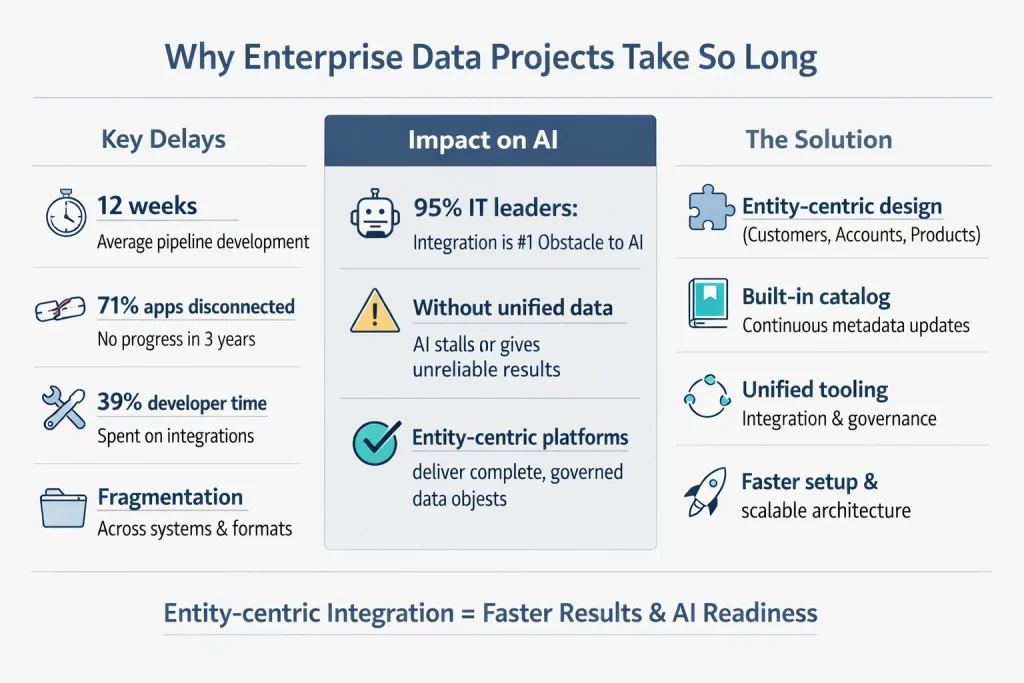
The core problem is fragmentation. Enterprise data projects live across dozens of systems, databases, and formats. Before teams can deliver anything useful, they spend weeks identifying dependencies, documenting schemas, and building pipelines manually, with pipeline development alone taking up to 12 weeks in many organizations (Informatica, 2025). On top of that, 39% of developer time is spent on designing, building, and testing custom integrations, leaving little capacity for addressing actual business priorities.
That’s where ETL platforms like K2view come in. Instead of managing data at the table level, entity-centric integration platforms organize everything around business objects (customers, accounts, products, claims). That structure removes most manual stitching, and because entity models are reusable, new projects don’t have to restart from scratch.
For AI and agentic use cases, this matters even more. If a system can’t retrieve a complete, current view of a customer or order, it will stall or produce unreliable results. Entity-centric data products package multi-source data together with the governance rules around it, making that data ready to use, not just available.
Automation Removes Much of the Manual Work
The biggest drag on enterprise deployments is manual configuration. Data project teams traditionally discover source systems, identify relationships, define metadata, and maintain documentation as separate, disconnected tasks. And most platforms require significant hand-holding to get there.
Established platforms like Informatica and MuleSoft are powerful. Still, Informatica is known for long implementation times and complex deployments, while MuleSoft implementations typically take between 2 and 6 months, with different teams handling different components. That’s a significant investment before any business value is delivered.
Newer entity-centric platforms take a different approach. Rather than requiring teams to build from scratch, they scan data landscapes, infer relationships, and automatically recommend entity structures, so teams start with a working model and refine it. That cuts setup time and reduces errors introduced by hand-mapping.
Built-in catalog capabilities also help after launch. When the catalog is integrated into the platform, it continuously updates metadata and handles schema drift. This reduces the “stale documentation” problem that slows teams down long after the initial rollout. According to Forrester, organizations that adopt this integrated approach can cut the time spent on data integration and management tasks by up to 30%. K2view is one example of a platform built around this model.
Entity-Centric Design Simplifies Deployment
Most traditional integration and ETL platforms organize data projects around technical structures such as schemas, tables and pipelines. That works at a technical level, but it often creates friction between IT and business teams who are trying to work from the same conceptual model.
Entity-centric platforms like K2view flip that structure. Instead of building integrations around disconnected technical components, they organize everything around complete business objects: a customer record that pulls together billing, support, CRM, and operational data into a single governed structure. Teams don’t need to rebuild those relationships for every new downstream use case because the model is reusable from the start.
That reusability is what keeps implementation time from multiplying as new projects come online. And it’s what makes these platforms particularly well-suited for organizations running multiple AI and modern project management initiatives in parallel.
Integrated Tooling Reduces Deployment Friction
Enterprise implementations often stall because teams are coordinating too many disconnected tools. One handles integration, another manages metadata, another governs masking, and another supports testing. Every handoff between tools is a potential delay.
Platforms that consolidate these functions into a single environment (visual development, cataloging, governance and synchronization policies) significantly reduce that friction. Teams spend less time on toolchain management and more time on actual delivery.
Today, newer platforms have an advantage over legacy approaches. MuleSoft excels at API-led connectivity but requires separate tooling for data governance and cataloging. Informatica covers more ground but comes with significant setup complexity. Platforms designed around a more unified model can move faster in practice, particularly for organizations without large, dedicated integration teams. Take K2view, which combines visual development, cataloging, governance, and synchronization into a single environment rather than requiring teams to stitch those capabilities together from separate products.
Faster Setup Supports Long-term Scalability
Quick implementation only matters if the platform holds up as data environments grow. Some tools deliver fast pilots but become difficult to maintain at scale.
The architecture matters here. Platforms that isolate business entities into manageable units (rather than treating everything as one large interconnected system) tend to handle growth better. They support high concurrency, allow security policies to be applied at the entity level, and adapt more gracefully when source systems change.
Automated handling of schema drift and metadata evolution also reduces long-term maintenance overhead. Instead of rebuilding integrations after every upstream change, well-designed platforms adapt with minimal manual intervention.
For organizations pursuing AI readiness, that combination (fast initial deployment plus low ongoing maintenance) is what distinguishes a platform that enables new initiatives from one that becomes a bottleneck.
Next Step
If your teams are under pressure to deliver governed, AI-ready data products without long implementation cycles, it’s worth considering how entity-centric integration platforms like K2view approach the problem. Implementing K2view is quick and easy – the fastest way to see it in practice is to take a product tour or request a demo.