

Table of Contents
Definition
Steering Committee (SteerCo)
A steering committee is a small group of senior people who give a project, programme, or business initiative its direction and make the decisions that are above the project manager’s authority: changes to scope, budget, and deadlines, stage approvals, and whether the work should continue at all. It is often shortened to SteerCo.
Every project eventually needs a decision that the project manager cannot make alone. A key supplier is late and the go-live date has to move. A department wants a feature that was not in the plan. The budget will run out a month early. A steering committee is where those decisions get made, quickly and by the people who have the authority to make them.
This guide explains what a steering committee is and what it decides, who sits on it, how it fits into a project governance structure, and how to run its meetings. It ends with a worked example from an ERP rollout and a free steering committee charter template you can adapt.
Key Takeaways
- A steering committee steers; the project manager manages. The committee makes the decisions that are outside the project manager’s authority and leaves day-to-day work to the team.
- Its members are senior people who own the outcome: usually the sponsor as chair, plus business, user, supplier, and finance representatives. Five to nine members is a common range.
- It only works with clear decision rights. Agree in advance which changes the project manager, the sponsor, and the committee can approve.
- Good meetings are about decisions, not status. The status report is read beforehand; the time in the room goes to the questions that need an answer.
- A steering committee is temporary. It is set up for a project or programme and dissolved when the work is closed.
What Is a Steering Committee?
A steering committee is a decision-making group that oversees a specific piece of work: a project, a programme of related projects, or an initiative such as a system replacement, a merger integration, or a reorganization. It does not do the work. It gives direction, approves the plan and major changes to it, removes obstacles the team cannot remove on its own, and checks that the work still supports the business case.
SteerCo is simply the short form of “steering committee.” You will see it in meeting invitations (“SteerCo, Thursday 10:00”) and status reports. In PRINCE2 the same body is called the project board, and in some organizations it is a project governance board or an executive committee for the project. The name matters less than the role: it sits between the organization’s leadership and the project manager.
A steering committee is set up for a defined piece of work and closed when that work is finished. That is the main difference from a standing body such as a board of directors or a permanent management committee.
What Does a Steering Committee Do?
The simplest way to describe a steering committee’s job is by the decisions it owns. A typical list looks like this:
| Decision or responsibility | When it comes up |
|---|---|
| Approve the project charter, plan, and baseline | At the start, after the business case is approved |
| Approve or reject changes to scope, budget, or dates above agreed thresholds | Whenever a change request exceeds the project manager’s and sponsor’s limits |
| Approve stage gates and the go-live or handover decision | At the end of each phase |
| Resolve issues the project cannot resolve itself, such as conflicts over people, priorities, or other departments’ cooperation | As they arise, usually at the next meeting |
| Decide on risks that threaten the business case | When a risk exceeds the project’s tolerance |
| Confirm that the project is still worth doing, or recommend stopping it | At each stage gate, or when assumptions change |
| Approve closure and hand over benefits tracking | At the end of the project |
Just as important is what the committee does not do. It does not assign tasks, review every deliverable, or rewrite the plan in the meeting. If the committee starts managing the project, the project manager stops managing it, and accountability becomes blurred.
Who Sits on a Steering Committee
Steering committee members are senior stakeholders, senior enough to commit money and people, and close enough to the outcome to care about it. The exact titles vary, but most committees cover the same perspectives:
| Role | Who it usually is | What they bring |
|---|---|---|
| Chair | The project sponsor or executive sponsor | Owns the business case and has the final say when the committee does not agree |
| Senior business owner | Head of the function that will own the result | Makes sure the project delivers the benefits the business expects |
| Senior user | A leader of the people who will use the result | Speaks for users: requirements, acceptance, readiness |
| Senior supplier | IT lead, vendor executive, or head of the delivery team | Speaks for those who build: feasibility, capacity, technical risk |
| Finance | Finance business partner or controller | Budget, contingency, and cost reporting |
| Project manager | The project manager | Reports status and brings decisions to the committee. Usually attends without a vote |
| Secretary | PMO analyst or project coordinator | Agenda, papers, minutes, and the decision log |
How many members? Most guidance suggests five to nine. Fewer than five and an important perspective is usually missing; more than nine and the meeting turns into a briefing where nobody feels responsible for the decision. If many departments need to be informed, keep them on the distribution list for the minutes rather than at the table.
Steering Committee vs. Sponsor, PMO, and Board
Several governance roles look similar from a distance. This table shows how they differ.
| Body or role | What it does | How it relates to the steering committee |
|---|---|---|
| Project sponsor | One senior person accountable for the business case and the benefits | Usually chairs the steering committee; makes decisions between meetings within agreed limits |
| Project manager | Plans and runs the project day to day | Reports to the committee and brings it decisions; does not chair it |
| PMO | Sets standards, supports projects, consolidates reporting | Supports the committee with reports and minutes; does not make its decisions |
| Project board (PRINCE2) | Executive, senior user, and senior supplier who direct the project | The same role under a different name |
| Advisory committee | Gives expert advice | Advises but has no decision rights |
| Board of directors | Governs the whole company on behalf of shareholders | A permanent body above the committee; may approve the business case or very large changes |
Project Governance Structure
A project governance structure defines who makes which decisions on a project, how information flows up, and how direction flows down. The steering committee is its central part, but the structure also covers the levels above and below it and the people who support it without deciding.
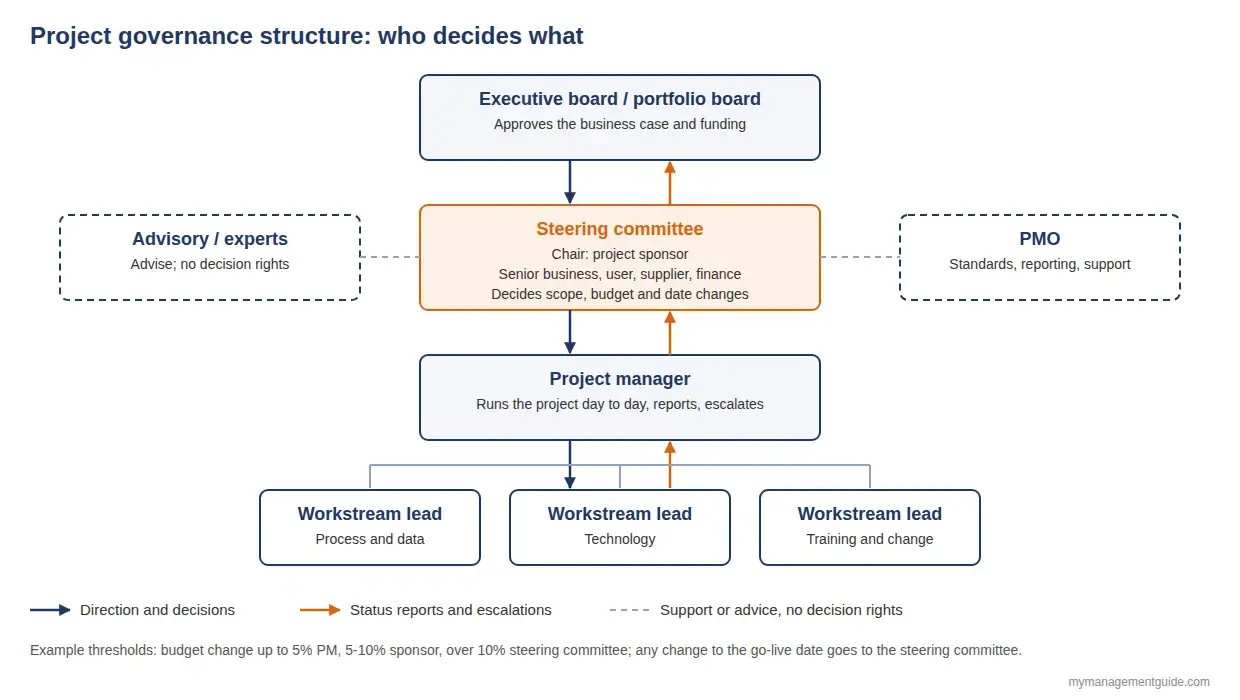
The diagram only works if everyone knows where each decision belongs. That is what decision rights and escalation thresholds are for. Agree them before the first meeting and write them into the committee’s charter. The numbers below are an example; set your own based on the size and risk of the project.
| Type of change | Project manager decides | Sponsor decides | Steering committee decides |
|---|---|---|---|
| Budget | Up to 5% of a work package | 5-10% of total budget | Over 10%, or any use of contingency |
| Schedule | Slips up to 2 weeks with no milestone impact | A milestone moves by up to 4 weeks | Any change to the go-live date |
| Scope | Changes within the approved scope | Minor changes with no cost or date impact | Any change to the deliverables in the charter |
| Risks and issues | Within the risk response plan | Needs people from another department | Threatens the business case or a regulatory requirement |
The governance section of the project implementation plan records this structure for each project. For what to write in that section, see project governance roles and responsibilities and project governance as a linkage mechanism in our Implementation Guide.
Three Project Governance Models
Organizations distribute decision-making in different ways. Three patterns are common:
- Centralized. One steering committee decides for the whole project or programme, and decisions flow down through the project manager. It gives consistent direction and clear accountability, and it suits large projects with one sponsor. The risk is a bottleneck: if the committee meets monthly, every escalation waits up to a month.
- Distributed. Decision rights are pushed down to workstream or sub-project boards, and the steering committee reviews periodically and handles only the largest changes. It is faster and suits programmes with several fairly independent parts. The risk is that decisions in one workstream conflict with another, so the thresholds and reporting rules need to be very clear.
- Hybrid. A central steering committee keeps the strategic decisions (scope, budget, go-live), while workstream boards decide within their own limits. Many large IT and transformation programmes end up here because it combines speed with a single point of accountability.
How to Set Up a Steering Committee in 6 Steps
- Write the mandate. One or two sentences on why the committee exists and what it is accountable for, agreed with the sponsor. Everything else in the charter follows from it.
- Choose the members. Cover the business, user, supplier, and finance perspectives with people who can commit resources. Name a deputy for each, so a missing member does not block a decision.
- Agree decision rights and thresholds. Decide what the project manager, the sponsor, and the committee can each approve, and how the committee decides: consensus, majority, or the chair decides when there is no agreement.
- Set the cadence. Monthly is typical. Meet more often around critical stages such as the last weeks before go-live, and agree how urgent decisions are made between meetings.
- Define inputs and outputs. What the committee receives before each meeting (status report, decision papers) and what it produces after (minutes and a decision log). A terms of reference document or a charter puts all of this on two or three pages.
- Plan the end. Write down when the committee is reviewed (for example, at each stage gate) and when it is dissolved, usually after project closure and the handover of benefits tracking.
Steering Committee Meetings: Agenda and Cadence
The most common complaint about steering committees is that the meetings are long status presentations where nothing gets decided. The fix is simple: send the status report and decision papers in advance, at least two or three working days before the meeting, and spend the meeting on the decisions. A 60-minute agenda can look like this:
| Time | Item | Lead |
|---|---|---|
| 5 min | Opening, quorum, conflicts of interest, previous minutes | Chair |
| 5 min | Actions from the last meeting | Secretary |
| 10 min | Status by exception: only what is off track and why | Project manager |
| 25 min | Decisions needed, one decision paper per item | Project manager |
| 10 min | Top risks and issues that need the committee’s help | Project manager |
| 5 min | Summary of decisions and actions, date of the next meeting | Chair |
A good decision paper fits on one page: the question, two or three options, the impact of each on scope, cost, date, and risk, and the project manager’s recommendation. After the meeting, record each decision in a decision log with its owner, date, and any conditions, and send the minutes within two working days. The project schedule and budget are then updated to match.
Steering Committee Example: An ERP Rollout
A manufacturing company with about 600 employees is replacing its old accounting and inventory systems with a cloud ERP. The project runs for 14 months. The steering committee has six voting members: the CFO as sponsor and chair, the operations director, the head of the finance shared service center (senior user), the IT director and the implementation partner’s engagement lead (senior supplier side), and the financial controller. The project manager and a PMO analyst attend without a vote.
Four months before go-live, the monthly meeting has three decision papers on the agenda. The status report, sent three days earlier, shows the project on budget but with data migration behind plan.
| No. | Question | Decision | Conditions and owner |
|---|---|---|---|
| 1 | The warehouse team asks to add a barcode scanning module to the first release | Rejected for release 1; added to the release 2 backlog | Operations director to confirm the manual workaround for the first three months |
| 2 | The second data migration test failed reconciliation. Move go-live by four weeks? | Approved: go-live moves from 1 March to 29 March | Third test must pass by 20 February, or the committee meets again. Owner: project manager |
| 3 | Release $60,000 of contingency for an extra data migration consultant for eight weeks | Approved | Financial controller to track against contingency; remaining contingency reported monthly |
Each of these decisions was above the project manager’s and the sponsor’s thresholds: a scope change to the release, a change to the go-live date, and use of contingency. Because the papers were read in advance, the three decisions took about 30 minutes. The decision log gave the project manager a clear basis for updating the plan the same afternoon.
Steering Committees in Other Contexts
The term is used well beyond project management. The role is similar, but the members and the decisions change with the setting:
- Corporate initiatives and transformations. A digital transformation, a reorganization, or a cost program often has a SteerCo of executives who set priorities across many projects.
- Mergers and acquisitions. An integration steering committee oversees the work after a deal closes: systems, people, customers, and synergies.
- Nonprofits, public bodies, and community programs. A steering committee may bring together funders, partner organizations, and community representatives to guide a program or a policy.
- Clinical research. A trial steering committee oversees the conduct of a clinical trial. It works under its own regulatory rules and is different from a project steering committee.
Common Mistakes
- Turning the meeting into a status report. If most of the time goes to slides about progress, decisions are rushed at the end or postponed.
- No agreed decision rights. Without thresholds, the project manager escalates everything or nothing, and both are expensive.
- Too many members. A committee of 15 is an audience. Keep the decision makers at the table and send the minutes to everyone else.
- Delegates instead of members. When members send someone without authority, decisions are deferred to the next meeting. Agree named deputies with the same authority.
- The project manager chairs the committee. The committee exists to make decisions the project manager cannot make, so it should be chaired by the sponsor.
- Nobody asks whether the project should continue. Checking the business case at each stage gate is one of the committee’s most valuable jobs, and the easiest one to skip.
Free Steering Committee Charter Template
The steering committee charter template (also called terms of reference) covers everything this guide describes: purpose and scope of authority, membership with deputies, responsibilities, decision rights and escalation thresholds, quorum and how decisions are made, meeting cadence and pre-reads, reporting, review and dissolution, and sign-off. Two appendices give you the 60-minute meeting agenda and a decision log. Gray guidance text explains what to write in each section.
Practice: Test Yourself
Eight questions on steering committees, governance structure, and the ERP example. Multiple choice, with an explanation after each answer.
Quick Knowledge Check: Steering Committee
8 questions. Takes about 3 minutes.
Frequently Asked Questions
SteerCo is short for steering committee. It is the group of senior people who give a project, programme, or initiative direction and make the decisions that are above the project manager’s authority.
Five to nine voting members is a common range. Cover the business, user, supplier, and finance perspectives with people who can commit resources, and keep everyone else informed through the minutes rather than at the table.
Monthly is typical for most projects. Meet more often around critical stages, such as the weeks before go-live, and agree a way to make urgent decisions between meetings, for example by email with a short deadline.
The project manager attends every meeting, reports status, and brings decisions to the committee, but usually does not have a vote. The committee exists to decide what the project manager cannot decide alone.
A steering committee makes decisions about a specific project or programme. A PMO (project management office) is a support function: it sets standards, helps projects with methods and tools, and consolidates reporting. The PMO often supports the committee, but it does not make its decisions.
A steering committee has decision rights: it approves plans, changes, and stage gates. An advisory committee gives expert advice and recommendations, but the decision stays with someone else.