

A trade show booth generates its value in about four seconds: the moment a rep reads a badge, decides whether the person is worth a follow-up, and captures why. Everything after that is logistics. And logistics is where most event pipelines leak, and where it gets hard to measure the ROI of trade show attendance at all.
Industry post-event surveys have long put badge-to-CRM lag at days or weeks, usually because leads sit in a spreadsheet until someone has time to clean them. Real-time CRM sync is the fix, but “sync” means very different things across vendors. Some push a name and email. Others push enriched contact data, qualification answers, an assigned owner, and a next step. It is the same problem sales teams solve when they automate CRM updates after every meeting, just compressed into a three-day show instead of a quarter.
This roundup compares event lead capture platforms on the criteria that actually decide whether a booth conversation becomes a sales record: capture method, enrichment, qualification workflows, CRM mapping, offline behavior, team collaboration, analytics, and cost per show. There is no universal answer to what is the best platform for B2B lead capture: the right fit depends on show volume, team size, and how deep the CRM integration needs to go.
Key Takeaways
- Popl reads printed badges without an organizer API. iCapture, Cvent LeadCapture, and Whova depend on supported providers or event ecosystems; momencio requires an API or its AI EdgeCapture add-on.
- Captello lists SOC 2 Type 2 and ISO 27001 certifications. Confirm current security documentation directly with each vendor.
- As of August 2026, momencio publishes annual-billed seat pricing with a five-seat minimum, but CRM integrations and AI EdgeCapture cost extra. iCapture and Popl require a quote.
- Popl’s claimed 90% enrichment success rate across 20+ data partners is self-reported, not independently tested. Ask how vendors define success and bill failed matches.
- Organizer-rented scanners can cost $15,000-$25,000 across 15 shows, typically delivering post-event exports rather than real-time CRM records. Compare total costs, including software add-ons.
What to Evaluate Before Looking at Any Vendor
These criteria hold whether you are picking the best lead capture platform for a small business running two shows a year or vetting an enterprise rollout across a full calendar:
- Capture independence. Does scanning require the organizer’s badge kit, event API, or rental agreement? If yes, coverage is show-by-show.
- Enrichment method. A single data provider fails more often than a layered approach. Ask what happens on a miss, and whether a miss is billed.
- Field mapping control. Qualification answers are worthless if they land in a CRM notes field nobody filters on.
- Offline mode. Convention center Wi-Fi is unreliable by default.
- Per-user cost. Booth staffing spikes for three days a year. Seat-based licensing punishes that pattern.
Event Lead Capture Options in Detail
Disclaimer: This list reflects our selection as of the guide’s latest update. We review it regularly and may add, remove, or reposition companies as market conditions and provider offerings change. Pricing, feature sets, and other vendor details mentioned in this guide reflect publicly available information and can change. Confirm current rates and contract terms directly with a vendor before signing an agreement. This guide is for informational purposes only and is not procurement or legal advice.
1. Cvent | iCapture


iCapture, now owned by Cvent and branded Cvent | iCapture, is built on official registration data rather than optical badge reading. As of August 2026 it advertises 130+ badge-provider integrations, which means scans pull the attendee record the organizer already holds, including titles, company details, and registration answers, with no typing required.
The app also supports business card and photo capture as fallbacks, and leads route into Salesforce, HubSpot, Marketo, Eloqua, or Microsoft Dynamics 365 with real-time scoring and segmentation based on the qualification answers a rep collects. Cvent’s own case studies cite exhibitors such as Truckstop.com and HiBob using it to connect captured leads to pipeline and revenue rather than just booth traffic counts.
Drawback: coverage depends on the show’s registration vendor being on that list, so it works best for teams that exhibit at Cvent-registered shows repeatedly. Contact enrichment requires bringing an existing ZoomInfo subscription, and pricing is request-only.
2. Cvent LeadCapture

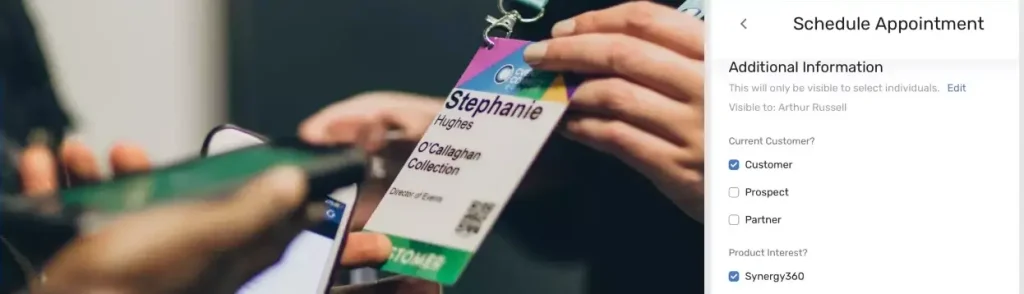
Cvent LeadCapture is the lighter capture module built for exhibitors at events the organizer itself runs on Cvent, as opposed to iCapture’s focus on third-party shows. Reps scan badges or business cards, qualify leads against custom on-the-spot questions, and rate them by priority directly in the app, with multiple booth staff able to capture at the same time.
An Exhibitor Portal gives real-time dashboards on lead volume and engagement during the show, and leads export on demand or sync into a connected CRM for same-day follow-up. Cvent cites exhibitors such as CPA Global, Merkle, and W.L. Gore & Associates using it inside their event programs, which keeps exhibitor lead data in the same reporting environment and simplifies attribution across an event program.
Drawback: it is best understood as a feature of the broader Cvent event platform rather than a standalone exhibitor tool, so it delivers the most value when registration, venue sourcing, and event marketing already run through Cvent. Teams that exhibit at third-party shows outside the Cvent ecosystem get less from it.
3. Captello

Captello positions itself as an event-to-revenue platform rather than a scanning app alone: capture, enrichment from more than 125 data sources, and CRM routing sit alongside a library of 60-plus gamification activities and prize logic that give reps a reason to start conversations in the first place.
Connexions, its networking layer, and CapChat, an AI feature for querying event data in plain language, feed a Revelation dashboard built to show attributed pipeline rather than raw lead counts. The platform is SOC 2 Type 2 and ISO 27001 certified, and Captello names enterprise clients including General Mills, Amazon, Intuit, Pfizer, and Sony.
Drawback: the gamification-first design means teams that only want fast scan-and-qualify workflows may be buying more platform than they need, and configuration takes real setup time before each show.
4. momencio

momencio combines badge, business card, and QR code scanning with AI lead enrichment that fills in business email, direct phone, job title, company size, industry, and LinkedIn profile data, and all of it works offline with automatic syncing once the booth is back online. Smart Notes lets reps capture a voice or text note on a conversation that attaches straight to the lead record, and reps can book a follow-up meeting on the spot. IntelliStream then tracks the fuller journey after the show, including email opens, microsite revisits, and content views, and syncs everything into Salesforce, HubSpot, Microsoft Dynamics 365, or Marketo. momencio cites customers in healthcare, financial services, and higher education, including Ashland, Penn Medicine, and Comcast.
momencio publishes seat pricing with online checkout, which is unusual in this category. As of August 2026 that is $100, $130, or $170 per seat per month billed annually with a five-seat minimum, putting the floor around $6,000 per year on a 12-month non-cancellable term with no free trial. Genuine strengths include kiosk self-check-in, gamification, LiveMicrosites for personalized follow-up content, and IntelliStream engagement analytics.
Drawback: standard badge scanning requires the show’s event API, purchased from the organizer. Capture and enrichment without an API is the separate “AI EdgeCapture” add-on, and CRM integrations and gamification are add-ons as well, so the effective cost can climb well past the seat rate.
5. Whova

Whova is an event app first, with lead capture as an exhibitor add-on rather than the core product. Exhibitors scan attendee QR codes through the mobile app, and the platform also supports passport-style contests with digital stamp collection and promotional offers as alternate ways to pull attendees to the booth. Captured leads organize centrally with custom scoring, export as a spreadsheet, and connect into a CRM for follow-up, while dedicated exhibitor chatrooms handle logistics during the show. Where the organizer already runs Whova, exhibitors also get attendee networking, agenda context, and in-app messaging alongside scanning, which extends engagement past the booth conversation itself.
Drawback: availability is tied to organizers who chose Whova for the event, so it cannot serve as a consistent tool across a full show calendar the way a standalone platform can.
6. Popl

Popl started as a digital business card app and now positions itself as a universal event lead capture platform, with badge scanning that reads the printed badge directly, so it works at shows using encrypted QR codes that block some competitors. Beyond capture, the platform adds list enrichment for bulk attendee data, on-site meeting booking, and an AI assistant for event support, and it integrates with Salesforce, HubSpot (where Popl says it is the top-installed lead capture app on the HubSpot Marketplace), Marketo, and more than 30 other tools. Popl advertises a 90% enrichment success rate through 20+ data partners; that is Popl’s own figure, not a tested result. The company reports 2.5 million professionals across 90% of Fortune 500 companies have used the platform, with more than 5,000 customer teams.
Drawback: as of August 2026 Popl publishes no pricing. Its own FAQ describes license plans, and every path leads to a sales call, which makes budgeting for a specific show calendar difficult before a quote.
7. Official Rental Lead Retrieval Scanners

The organizer’s own scanner, typically supplied through the show’s official registration and services contractor such as CompuSystems, GES, or Freeman, remains the default at many shows, and it has one real advantage: guaranteed access to the official attendee record for that event, with no integration work and no vendor evaluation needed. It is ordered directly through the exhibitor service kit alongside booth furniture and electrical, which makes it the path of least resistance for a one-off show.
Drawback: cost and lock-in. Published 2026 ATD and AAOS order forms show $350 to $735 per rep, per show, so a four-person booth runs roughly $800 to $1,000 for a single event, and a 15-show year can reach $15,000 to $25,000. Data typically arrives as a post-event export, not a real-time CRM record, and qualification options are limited to whatever the vendor offers.
Practical Selection Advice: How to Choose an Event Lead Capture Platform
There is no single best platform for event lead capture, and the best event lead capture platform for trade shows in particular depends on show volume, team size, and how deep CRM integration needs to go.
The lead capture challenges most trade show teams run into, though, are predictable, and they follow the same pattern as any software vendor comparison:
- Map the show calendar first. Count how many events actually sell an API or use a supported badge provider. That single number rules several vendors in or out.
- Model cost per lead, not cost per license. Divide the annual contract by realistic annual lead volume and compare against metered options.
- Ask what a failed enrichment costs. Some vendors consume credit on a miss.
- Test the CRM mapping in a sandbox before the show, using the qualifiers sales will actually filter on.
- Assign owners at the booth. Lead assignment after the fact is where follow-up speed dies.
Where This Category Is Heading
The technical question is shifting. Reading a badge is close to solved, whether through official registration data or optical capture of printed text. The harder problems are verification quality, transparent unit economics, and how much sales context travels with the record into the CRM.
Expect continued pressure on seat-based and rental pricing as usage-based models make cost per lead visible, and expect enrichment accuracy claims to be held to stricter definitions. Teams that document their own match rates and follow-up speed will be best positioned to judge which vendor claims hold up, whichever lead capture software for events ends up on the shortlist.
Frequently Asked Questions
What does “real-time CRM sync” actually mean in event lead capture software?
It varies by vendor. At the basic end, a platform pushes just a name and email into the CRM after a scan. At the more complete end, it also pushes enriched contact data, the rep’s qualification answers, an assigned follow-up owner, and a next step, so the record that lands in the CRM is something a sales rep can act on immediately rather than research later.
How much does event lead capture software cost?
Pricing structures differ enough that cost per license and cost per lead can tell very different stories. Some platforms bill per scan or per enriched lead with volume discounts, others sell seat-based annual licenses with a per-seat, per-month rate and a minimum seat count, and organizer-rented scanners charge a flat per-rep, per-show fee. Since booth staffing is usually a handful of people for a few days a year, it is worth modeling the annual cost against realistic lead volume rather than comparing sticker prices directly.
What happens if a scan cannot be matched to a real contact?
This is worth asking about before choosing a platform, since some vendors bill for a scan even when enrichment fails to find a verified match, while others only charge when enrichment succeeds. The difference can matter a lot at volume, so it is one of the practical questions to raise with any vendor before signing.
Do these platforms still work without reliable Wi-Fi at the venue?
The better ones offer an offline mode that queues scans locally and syncs once a connection is available, which matters because convention center Wi-Fi is unreliable by default. It is worth confirming this specifically, since not every platform handles a dropped connection the same way.
Is the organizer’s own rental scanner a reasonable alternative to a dedicated platform?
It guarantees access to the official attendee record for that one event with no integration work, which is a real advantage. The trade-offs are cost and lock-in: rental scanners are typically priced per rep, per show, which adds up fast across a full show calendar, and the data usually arrives as a post-event export rather than a real-time CRM record.
What is the best AI event lead capture platform?
There is no single winner, because vendors mean different things by “AI.” Some use it for optical reading of a printed badge so scanning does not depend on an organizer API, others for the matching layer that turns a scanned name into a verified contact, and some for both. The more useful question is what the AI is actually doing (capture, enrichment, or lead scoring) and whether the accuracy numbers a vendor quotes are independently tested or self-reported, before treating “AI-powered” as a deciding factor on its own. The same discipline applies to evaluating AI-branded software generally, which our guide to top AI development companies covers in more depth.